Chile has two things a skier from the northern hemisphere rarely gets together: winter in July and big mountains close to a capital city. From Santiago you can be on a chairlift in about an hour, and further south the ski areas sit on the flanks of volcanoes, some of them in araucaria forest. We run our winter trips in these mountains, so this guide covers what we explain to every skier who writes to us: when to come, where to ski, what changes once you leave the lifts and the practical details that decide how the trip goes.
Skiing in Chile at a glance
- Season: resorts usually open between late May and June and run until September, and into October in some southern areas, according to SERNATUR's official travel site.
- Peak months: July and August, the months SERNATUR recommends for winter sports.
- Closest resorts to Santiago: El Colorado, La Parva and Valle Nevado, above the village of Farellones, about an hour away. Portillo is about 2 hours away, near the Argentine border.
- Altitude: Valle Nevado's village sits at 3,025 m (9,924 ft), La Parva's at 2,750 m and Portillo's hotel at 2,800 m.
- South: volcano ski areas such as Nevados de Chillán, Corralco, Antillanca and the ski areas on Villarrica and Osorno.
- Beyond the lifts: ski touring from the resorts near Santiago and in the Cajón del Maipo, volcano descents in La Araucanía and the Lake District, and heli-skiing in the Central Andes.
When is ski season in Chile?
Ski season in Chile follows the southern hemisphere winter. SERNATUR, Chile's national tourism service, says the ski centers usually open between late May and June and the season generally runs until September, extending into October in some southern areas. It also notes that exact dates change every year with the weather, so treat any opening date you read as a target, not a promise.
For most visitors, July and August are the core of the season. SERNATUR recommends those two months for winter sports, and they line up with the northern summer holidays, which is why so many skiers from the United States and Europe plan their Chile trip for those weeks. Expect more people on the mountain at weekends at the resorts near Santiago.
Snow and weather patterns
Snow in the Central Andes arrives in storms, with long spells of clear, dry weather in between. Portillo, for example, describes its climate as around 80% sunny days and lists 5.10 m of annual snowfall. In practice that means a lot of bluebird skiing, strong sun at altitude and snow conditions that depend on when the last storm came through. After a big storm the roads up can close for a while, which is one reason many skiers choose to sleep on the mountain rather than drive up from Santiago every day.
Further south, the ski areas are lower and closer to the Pacific weather systems, so the landscape and the snow feel different: forested slopes, volcanic cones and, on some days, low cloud that clears to views of the next volcano.
Early, mid and late season
- June: the season starts, but how much terrain is open depends on early storms. Good for flexible travelers who can move dates.
- July and August: the most reliable period for snow cover and the busiest weeks. This is when we run our fixed departure for the Three Volcanoes Ski Traverse.
- September and October: longer days and spring snow. Some resorts start to close in September, while others and the southern areas can run into October. Check each resort's own site before booking late-season dates.
It depends. If I want comfort, dry powder and a lot of skiable terrain, I choose the Central Andes. If I want something more adventurous, with unique views and wild nature, I choose southern Chile and its volcanoes.
The Central Andes near Santiago
The Central Andes rise directly behind Santiago, and they are where most people ski in Chile. Two areas matter here: the resorts above Farellones, often called Tres Valles, and Portillo, on the road to Argentina. You can read more about the region on our Central Andes destination page.
Tres Valles: El Colorado, La Parva and Valle Nevado
Three resorts share the high valleys above the village of Farellones, about an hour's drive from Santiago. Farellones is where skiing in Chile began: the resort at El Colorado describes how the first group of skiers, known as "Los Pioneros", reached these mountains in 1932, and how the village grew into a cluster of stone chalets. El Colorado's site calls Farellones "the heart of the 3 Valleys".
- El Colorado sits just above Farellones. According to Santiago's regional tourism portal, its runs span 2,430–3,333 m, with 1,100 hectares of skiable terrain and 101 catalogued runs. It is the first resort you reach on the road up.
- La Parva is a ski village at 2,750 m, less than an hour from Santiago, with 800 hectares of skiable terrain, more than 40 runs and 15 lifts, five of them chairlifts. Its longest run is 4 km, and some of its downhill slopes are FIS-approved and used by international teams for training. From the slopes you look straight down on Santiago's central valley. La Parva also lists an interconnection run to Valle Nevado.
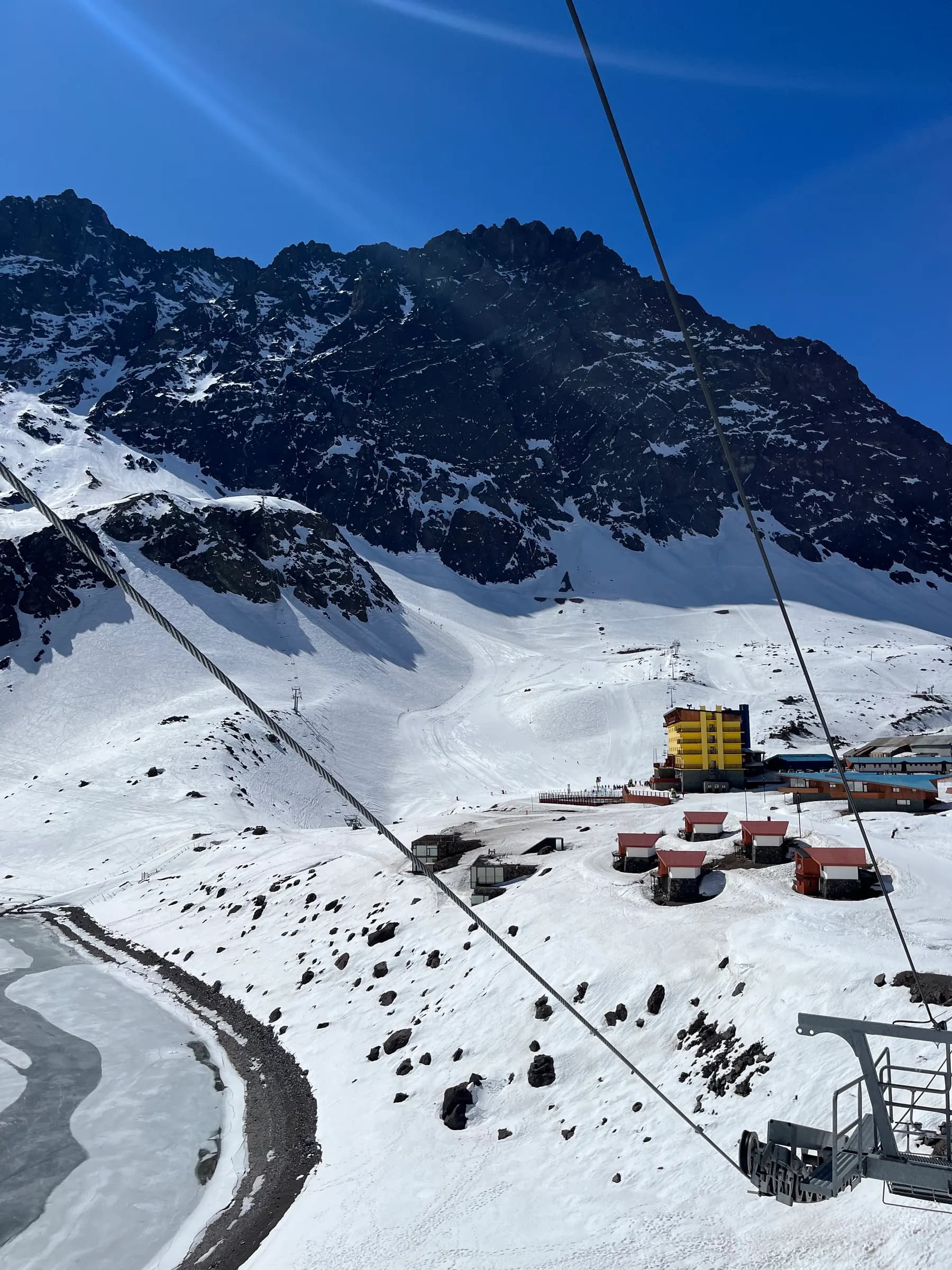
- Valle Nevado opened in 1988 at 3,025 m (9,924 ft), inside the Yerba Loca Nature Sanctuary, about 71 km (44 miles) from Santiago's international airport. It installed Chile's first gondola in 2013. Its website also lists partnerships with international ski passes, so if you already hold one, check the current season's terms before you buy lift tickets.
The road to all three is route G-21 from Santiago, a climb of 40 hairpin curves after the Corral Quemado bridge. For Valle Nevado you turn off at curve 40 onto route G-251. More on the road rules below.
Day trips or a stay on the mountain? You can ski Tres Valles as day trips from Santiago, but the drive, the chain checks and the traffic rules on the road add time to each day. Sleeping in Farellones, La Parva or Valle Nevado gives you first lifts without the commute. On our Tres Valles Resort Ski Tour you ski one resort per day, always on-piste, with a bilingual guide and two nights in the mountains, from June to October.
Portillo
Portillo is a single resort above Laguna del Inca, 3 km from the Argentine border and about 2 hours from Santiago by highway, following Ruta 60 through Los Andes toward Paso Los Libertadores. Its hotel sits at 2,800 m and the ski terrain tops out at 3,310 m.
The numbers explain Portillo's character. It has around 500 hectares and 35 runs, with a terrain mix the resort puts at 15% beginner, 30% intermediate, 30% advanced and 25% expert. The longest run is 2.5 km. With a limit of 450 resort guests and a limited number of day tickets, the resort says there are rarely lift lines. Portillo also runs its own "va-et-vient" lifts on steep chutes: pulley systems that pull five skiers up side by side.
Valle Nevado vs Portillo
This is the most common comparison we get, and the honest answer is that they suit different trips.
| Valle Nevado | Portillo | |
|---|---|---|
| Altitude | Village at 3,025 m | Hotel at 2,800 m, top of terrain 3,310 m |
| From Santiago | About 71 km from the airport, via Farellones | About 2 hours by highway, near the border |
| Feel | Modern resort village with a large lift network and gondola | One hotel, limited guests and day tickets, few lift lines |
| Neighbors | Linked area with La Parva and El Colorado nearby | Isolated, no other resort next door |
| Terrain | Runs for every level | 55% of terrain rated advanced or expert by the resort |
If you want variety and the option to ski three resorts in one trip, Valle Nevado and its neighbors make more sense. If you want a quiet base, steep terrain and few people, Portillo fits. Our Valle Nevado and Portillo ski trip does both: ten days, three full ski days at Valle Nevado and four at Portillo, with a private bilingual guide, a 7-day ski pass for both resorts and ski or snowboard rental included. It runs from June to September and works for all levels.
The south: skiing on volcanoes
South of Santiago the Andes get lower and the ski areas move onto volcanoes. The terrain is more open, the views include other cones and lakes, and in La Araucanía the lower slopes are covered in araucaria, the monkey-puzzle tree. These areas are a long way from Santiago, so most skiers fly to a southern city or combine them with a wider trip.
- Nevados de Chillán, in the Ñuble Region, is about 80 km from the city of Chillán on Route N-55. SERNATUR describes more than 30 runs on the slopes of the Chillán volcano, including Las Tres Marías, a 13 km descent through native forest, and thermal pools at the resort.
- Corralco sits on Volcán Lonquimay inside the Malalcahuello National Reserve, which CONAF manages and which is part of UNESCO's Araucarias Biosphere Reserve, created in 1983. The forests there include araucaria, coigüe, roble and lenga.
- Las Araucarias, in Conguillío National Park northeast of Temuco, skis below Volcán Llaima among araucaria forests and mountain lagoons, according to SERNATUR.
- Villarrica and Osorno both have ski areas on their lower slopes. Villarrica National Park, above Pucón, lists ski runs among its services, and on Osorno the road from Puerto Varas runs 57 km to Ensenada and then 14 km up to the ski area.
- Antillanca, in Puyehue National Park on Volcán Casablanca, is about 100 km from Osorno on Route 215, roughly 2 hours by road.
The south is also where Chile's volcano ski touring happens, which we cover next. If you are interested in these mountains in summer, our guide to climbing volcanoes in Chile covers the ascents on foot.
Beyond the lifts: backcountry, ski touring and heli-skiing
The resorts are only a small part of the snow in the Andes. Above and between them there is high, ungroomed terrain, and that is where experienced skiers spend many of their days in Chile. It is also where mountain judgment matters most: snowpack, wind and visibility decide what is possible, and every one of these days depends on them.
Ski touring from Tres Valles
The resorts above Farellones are good starting points for touring because the lifts get you high quickly. On our Tres Valles Backcountry trip, a certified mountain guide (UIAGM or national certification) leads three days: Santa Teresita from El Colorado, Falsa Parva with a descent via La Chimenea from La Parva, and a tour toward Cerro El Cepo, a 4,309 m peak that Andeshandbook notes can be reached from both La Parva and Valle Nevado. Avalanche safety equipment (transceiver, shovel and probe) is included, and the trip runs from June to September for groups of 2 to 6 who already know how to skin and ski off-piste.
The Cajón del Maipo
The Cajón del Maipo is the canyon southeast of Santiago, and in winter its upper valleys hold snow with no lifts at all. Our backcountry day in the Cajón del Maipo starts with a transfer of about 2 hours from Santiago to Valle Las Arenas, at the foot of Volcán San José near Lo Valdés and Baños Morales. You climb for 4–6 hours and ski the couloirs your guide chooses for the day's snow. If the snowpack or visibility do not allow it, the alternative is Cerro Unión (3,658 m). This is for intermediate to advanced off-piste skiers with basic transceiver skills, from June to September.
Volcanoes in La Araucanía and the Lake District
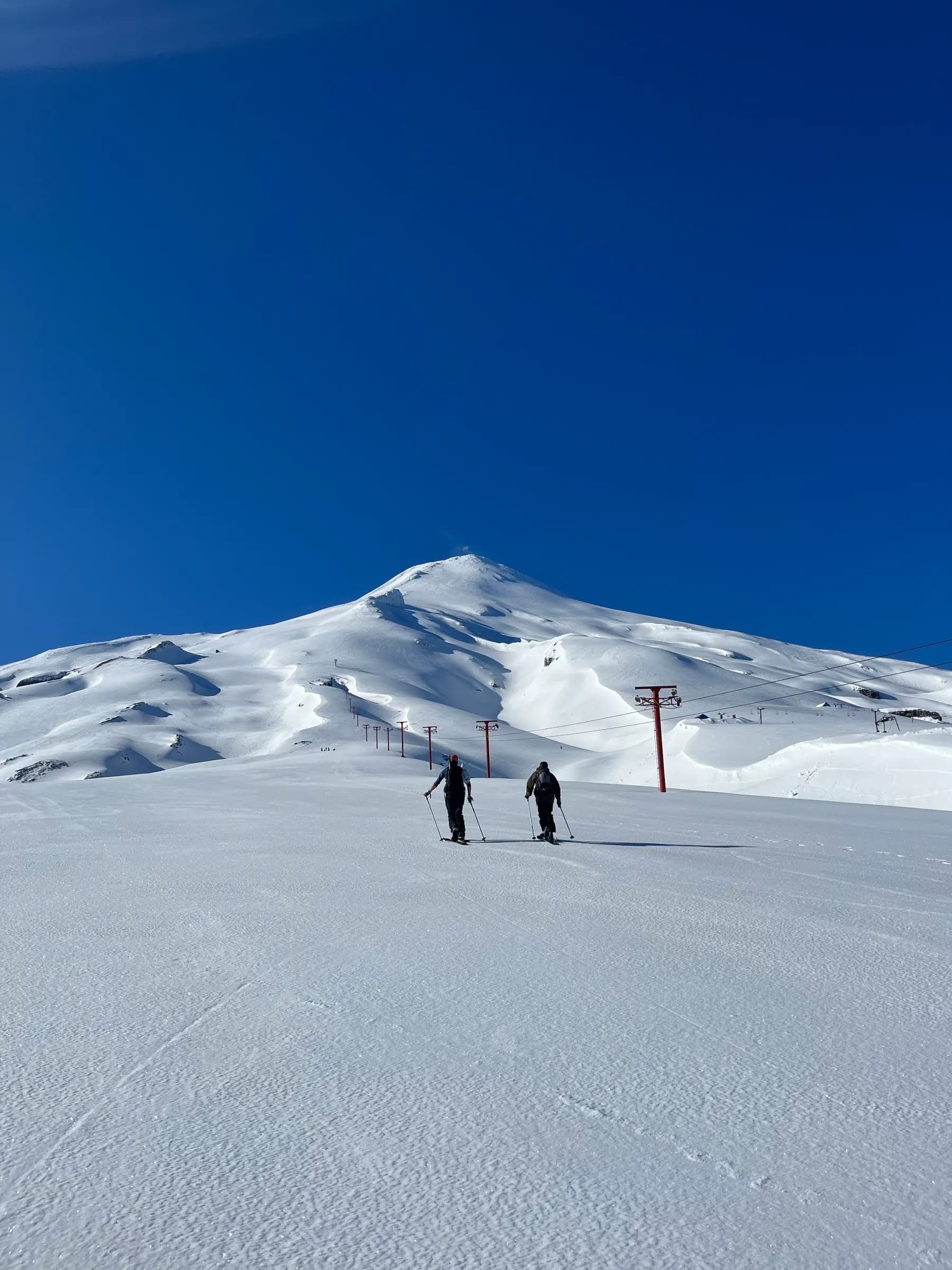
Skiing a volcano means a long climb on skins, often with crampons near the top, and a descent of 1,000 m or more down an open cone. On Villarrica (2,847 m), above Pucón, the climb to the crater takes about 4 to 5 hours, and in winter the Villarrica ascent finishes with a ski descent for advanced skiers, from July to October.
Our Three Volcanoes Ski Traverse links three of these in ten days: Lonquimay (2,865 m), Villarrica and Osorno (2,652 m), with touring days around Corralco in the araucaria forests of the Malalcahuello reserve. A certified mountain guide (UIAGM or national certification) leads every touring day, the group is 4 to 6 people, and it is a trip for advanced ski tourers. It runs from July to October, with small-group fixed departures in July and August listed on our fixed departures page.
Heli-skiing in the Andes
Heli-skiing in Chile reaches snowfields and glaciers that no lift serves. Valle Nevado itself lists heli-skiing among its services. Our heli-skiing day leaves Santiago early, flies to terrain in the Central Andes up to about 3,000 m and returns to the city in the evening, with a certified mountain guide (UIAGM or national certification) leading every descent and avalanche equipment and an airbag backpack included. Groups are 2 to 4, it runs from July to September, and you need real experience in deep, off-piste snow. The number of flights and descents always depends on snow, wind and visibility on the day.
What you need for the backcountry
- Experience: none of these days is the place to learn touring or powder skiing. You should be comfortable on skins, with kick turns and transitions, and skiing variable snow.
- Avalanche equipment: transceiver, shovel and probe, and the skills to use them. Check what each trip includes; on some it is provided, on others it is rented.
- A certified guide: the terrain is high and remote, and decisions about routes and snowpack are a guide's job.
- Insurance that covers it: many travel policies exclude off-piste skiing or ski touring. Read yours before you book.
The snow changes. In the center it is drier and lighter, the slopes have great pitch, and the powder is world class, nothing to envy the Alps. In the south the landscapes are unique, and the snow is wetter but builds up well. Sunny spring days, or the days after a storm, are spectacular.
Altitude: what to expect
The resorts near Santiago are high by North American and European standards. Valle Nevado's village is at 3,025 m, La Parva's at 2,750 m, Portillo's hotel at 2,800 m, and El Colorado's runs reach 3,333 m. Santiago itself is much lower, so a transfer from the city takes you to resort altitude in a couple of hours.
The US Centers for Disease Control and Prevention (CDC) says any unacclimatized traveler going to a sleeping altitude of 2,450 m (8,000 ft) or more is at risk of altitude illness, and advises against going directly from low altitude to a sleeping altitude above 2,750 m (9,000 ft) in one day. The most common symptom of acute mountain sickness is headache, sometimes with nausea, dizziness or fatigue, usually starting 2–12 hours after arrival. The CDC also recommends avoiding alcohol and keeping exercise mild for the first 48 hours at altitude.
What that means for a ski trip:
- Keep your first afternoon on the mountain light. On our Valle Nevado and Portillo trip, day 2 has a free afternoon after the drive up for exactly this reason.
- Ski easier terrain on day one and save the long, high runs for later.
- Drink water and go easy on alcohol the first couple of nights.
- If you have a medical condition or concerns, talk to your doctor before you travel.
The sun is strong at these altitudes, and the snow reflects it. Bring high-SPF sunscreen, lip balm and goggles or sunglasses with good UV protection.
Practical logistics
Getting there
Santiago's Arturo Merino Benítez International Airport (SCL) is the gateway for almost every ski trip in Chile. From there, Tres Valles is about an hour by road and Portillo about 2 hours. For the south, domestic flights from Santiago reach cities such as Concepción, Temuco and Puerto Montt; on our volcano traverse, for example, the group flies Santiago to Temuco and back from Puerto Montt.
US citizens do not need a visa for tourist stays of 90 days or less, according to the US State Department. Check the current entry rules for your own passport before you book.
Roads and chains
- Farellones road (G-21): during the ski season, from June to early October according to La Parva, vehicles must carry chains. Carabineros check them at La Ermita, at kilometer 12 on the road up. On weekends and holidays the road can run in one direction only at set hours (downhill-only in the afternoon, for example), so check the current schedule on the resorts' sites before you drive.
- Portillo (Ruta 60): Portillo notes that the road opening depends on the Carabineros post at Guardia Vieja, and the road can close in storms. For any crossing into Argentina, Chile's consular service says carrying chains is always required.
- South: the US State Department notes that flooding and landslides are most common in Chile from May to August, and roads in remote areas range from paved to gravel. Allow extra time on mountain roads in winter.
If you would rather not deal with chains, road schedules and mountain driving in a rental car, a private transfer handles it. All our winter trips include transfers.
Travel insurance
The US State Department strongly recommends supplemental insurance that covers medical evacuation in Chile. For a ski trip, check three things: that your policy covers skiing, that it covers off-piste skiing or ski touring if you plan to leave the resorts, and that it includes evacuation from the mountains. Travel insurance is not included in our trips, and on the backcountry trips we ask that your policy covers backcountry skiing.
Gear and what to pack
- Ski or snowboard clothing in layers: waterproof jacket and pants, base and mid layers, warm gloves.
- Goggles, sunglasses, sunscreen and lip balm for high-altitude sun.
- Your own boots if you can bring them; rental is available at the resorts, and some of our trips include it.
- For touring: a full touring setup, avalanche equipment and a daypack big enough for shovel and probe.
Planning your ski trip with us
Chile works for very different ski trips, and the right one depends on your level and how much time you have:
- A week or more of resort skiing: Valle Nevado and Portillo, ten days with a private bilingual guide.
- A short trip from Santiago: the Tres Valles Resort Ski Tour, three resorts in three days, on-piste.
- Ski touring near Santiago: Tres Valles Backcountry or a day in the Cajón del Maipo.
- Volcanoes: the Three Volcanoes Ski Traverse or a single Villarrica ski ascent.
- A day above the lifts: heli-skiing in the Andes.
If you are not sure which fits, tell us your dates, your group and the kind of skiing you like. We plan winter trips in the Central Andes and the south every season, and we will tell you honestly which option suits you.