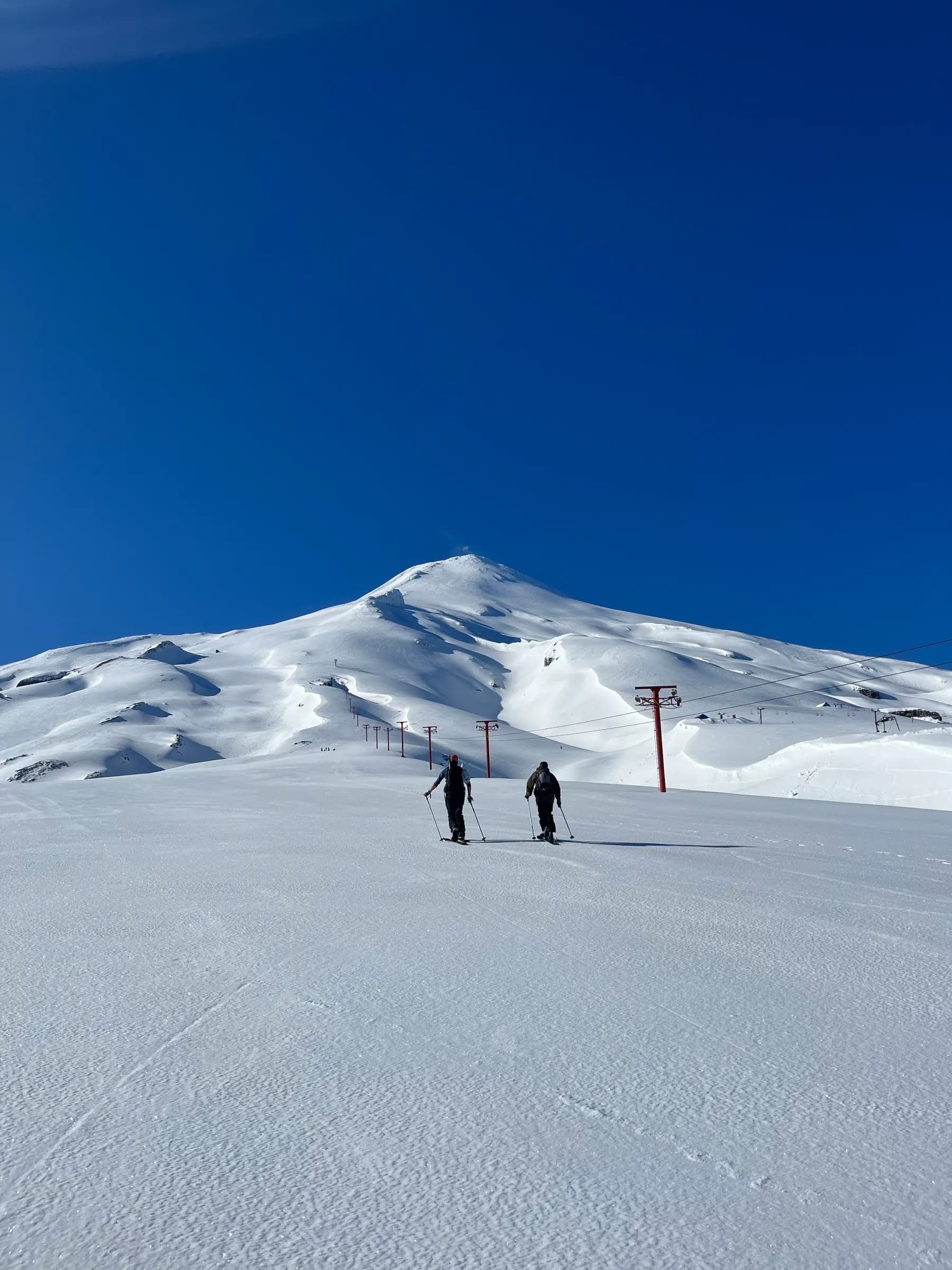
Southern Chile has volcanoes you can climb in a day from a lakeside town, on foot in summer or with skis in winter. We guide four of them: Villarrica above Pucón, Osorno above Puerto Varas, Lonquimay from Malalcahuello and Llaima in Conguillío National Park. This guide explains what each climb asks of you, when to go, what gear you need and which rules apply on the mountain, so you can match the volcano to your experience.
We are Matías Córdova, a Torres del Paine guide, and Diego Costa, a ski instructor who specializes in the Central Andes. The heights, distances and rules below come from SERNAGEOMIN, CONAF, the Municipality of Pucón, published research and our own trip data.
At a glance
| Volcano | Height | Base town | When we climb it | Level |
|---|---|---|---|---|
| Villarrica | 2,847 m (9,341 ft) | Pucón | Nov–Mar on foot; Jul–Oct with skis | Intermediate on foot, advanced with skis |
| Osorno | 2,652 m (8,701 ft) | Puerto Varas | Nov–Mar and Jul–Oct | Advanced: prior winter or glacier experience recommended |
| Lonquimay | 2,865 m (9,400 ft) | Malalcahuello | Jul–Oct | Intermediate on foot, advanced to ski down |
| Llaima | 3,125 m (10,253 ft) | Malalcahuello | Nov–Mar, on the Multi-Volcano Summer | High; crampon experience is a plus |
Why Chile is a volcano-climbing country
Chile runs along the edge of the South American plate, and volcanoes follow the Andes for most of its length. In its national volcanic risk ranking, SERNAGEOMIN, Chile's geological survey, assessed 92 volcanic systems that it considers geologically active. Counting every cone, Chile's official tourism site estimates there are more than 2,000 volcanoes in the country.
The volcanoes we climb all sit in the Southern Volcanic Zone, the stretch of the Andes between about 33° S and 46° S. A 2024 review in the journal Andean Geology counts 57 active volcanoes in this zone, 41 of them in Chile, 9 in Argentina and 7 on the international border.
What makes this part of Chile good for climbing is the shape of the mountains. Villarrica, Osorno, Lonquimay and Llaima are single cones that rise well above the surrounding forest and lakes, with snow and glaciers on their upper slopes for much of the year. Roads reach ski areas on their flanks, so a summit day starts from a car park rather than a multi-day approach. On Villarrica, for example, the normal route starts at the base of the ski area at around 1,450 m and climbs roughly 1,400 m to the crater rim.
These are also active volcanoes, and they are watched closely. SERNAGEOMIN's National Volcanic Monitoring Network follows them, and the same Andean Geology review notes that Villarrica ranks highest in Chile's volcanic threat ranking. In practice, that means two things for you: every climb depends on conditions on the day, and the decision to continue, turn around or change objective belongs to your guide.
The four volcanoes we climb
Volcán Villarrica (2,847 m), from Pucón
Villarrica is the volcano most people picture when they think of climbing in Chile: a snow cone above Pucón and Lago Villarrica, with a smoking crater at the top. It stands in Villarrica National Park, created in 1940 and managed by CONAF, which covers 53,460 hectares.
On our Volcán Villarrica Ascent, the day starts early in Pucón. At the base, your guide gives a safety briefing and fits your crampons, ice axe, helmet and harness. From there it's about 4 to 5 hours of climbing over snow and glacier to the crater at 2,847 m. Plan on 5 to 7 hours of continuous, steep effort in total.
On foot, we rate Villarrica intermediate. It is not a technical climb, and you don't need mountaineering experience, but it is physically demanding and includes glacier walking on crampons. CONAF classifies its crater trail as demanding and warns of rockfall on that route between December and April. Near the top, the smell of sulfur from the crater is strong. You look down into an active, smoking crater; whether you see more than that depends on the volcano and the weather, so we never promise lava.
In summer, the descent is on foot or sliding down the snow when conditions allow. From July to October the climb is the same, followed by a ski descent for advanced skiers. Groups are 1 to 6 people, and on bad days your guide may switch the objective to a different volcano for safety.
Standing on the rim of Villarrica is impressive. Skiing an active volcano doesn't happen every day, and in Chile it's something you can do on a weekend with good weather.
Volcán Osorno (2,652 m), from Puerto Varas
Osorno is the near-perfect cone above Lago Llanquihue, inside Vicente Pérez Rosales National Park. CONAF created the park in 1926, and it covers 253,568 hectares of the Andes east of Puerto Montt.
Osorno is a different kind of climb from Villarrica. It is a glaciated volcano: its slopes have crevasses, there is a bergschrund below the summit and rime ice near the top. The normal route gains about 1,400 m from the parking area near the Osorno ski area to the summit, and the upper mountain is glacier terrain where crampons and an ice axe are needed.
On our Osorno Volcano Ascent, you meet your guide the day before for a mandatory briefing and equipment fitting. On climb day, pickup at your hotel in Puerto Varas is at 4:30 am, and you start walking before 6 am. Around 9 am you switch to crampons and ice axe for the glacier. Expect about 5 to 6 hours of climbing to the summit. The group has a strict 1 pm summit cutoff: if you're not on top by then, you turn around. You're back at the parking area around 5 pm and at your hotel the same evening.
We rate Osorno advanced. The climb is for people in very good physical condition, and prior winter or glacier mountaineering experience, with crampon and ice-axe skills, is recommended. It is not a first mountain for beginners. Groups are 1 to 4 people, and your certified mountain guide carries a rope, a first-aid kit and an inReach satellite communicator. We run it in summer, from November to March, and in winter, from July to October, when advanced skiers can descend on skis.
Volcán Lonquimay (2,865 m), from Malalcahuello
Lonquimay rises inside the Malalcahuello National Reserve, in La Araucanía. CONAF has protected this area since 1931; it covers 13,882 hectares of araucaria, coigüe, roble and lenga forest and is part of the Araucarias Biosphere Reserve, recognized by UNESCO in 1983. SERNAGEOMIN lists Lonquimay at 2,865 m. Its 1988–1990 eruption formed the Navidad cone at the east-northeast foot of the main cone, and you can see it from the upper mountain.
Our Volcán Lonquimay Ascent is a full day from Malalcahuello, run from July to October. After a briefing, your certified mountain guide fits everyone with crampons, ice axe, helmet and harness, all included, and you climb for about 4 to 5 hours to the crater. The whole day asks for 5 to 7 hours of continuous effort.
Lonquimay's slopes are wide and open, which is why we like it for pairing a summit day with a ski descent. On foot it is not a difficult mountain and you don't need technical experience; skiing down requires an advanced level. Groups are up to 6 people, and the hot springs near Malalcahuello are a good way to finish.
Volcán Llaima (3,125 m), on the Multi-Volcano Summer
At 3,125 m, Llaima is the highest of the four. It stands in Conguillío National Park, created in 1950, a 60,832-hectare park known for its araucaria forests. Llaima is an active composite volcano with around 37 recorded eruptions since 1852, and near the top you'll see fumaroles and sulfur-stained ground around the crater.
We climb Llaima only as part of the Multi-Volcano Summer, a seven-day trip that links three ascents: Villarrica on day 2, Llaima on day 4 and Osorno on day 6, with a travel and recovery day between each one. Llaima is the longest day of the trip, about 14 km on foot from our base in Malalcahuello, on terrain that mixes hard snow with loose volcanic scree, so crampons and ice axe come into play. Across the three ascents you cover about 35 km.
The trip runs from November to March for groups of 1 to 6 and is rated high. It calls for high physical fitness. No technical climbing experience is required, but you need to be comfortable on long, steep days, and having walked in crampons before helps. Your guide runs technical briefings, and the technical gear (rope, helmet, ice axe, crampons and harness) is included.
Summer climbs vs winter ascents with ski descents
The same volcanoes give two very different trips depending on the season.
Summer (November to March). This is the season for climbing on foot. Our Multi-Volcano Summer runs in these months, and summer is when we take most first-time volcano climbers up Villarrica. You walk on snow, glacier and volcanic ground, using crampons and ice axe on the upper slopes. On Villarrica, the descent can be partly on foot and partly sliding down the snow when conditions allow.
Winter (July to October). In winter the volcanoes become ski terrain. On Osorno, snow usually starts somewhere between 1,700 and 2,000 m. The climbs on Villarrica, Osorno and Lonquimay can all end with a ski descent if you are an advanced skier and conditions allow. You still use crampons on hard snow and ice, and your guide decides on the day how far you go on skis and how far on foot.
For experienced ski tourers, our Three Volcanoes Ski Traverse puts the winter season into one trip: ten days of backcountry touring with a certified mountain guide (UIAGM or national certification) on Lonquimay (day 3), Villarrica (day 7) and Osorno (day 9), plus touring days around the Corralco ski area chosen according to snow conditions. It is for advanced ski tourers who are comfortable with long ascents on skins, kick turns and transitions, and skiing steep, variable snow. Groups are 4 to 6, and fixed small-group departures are planned for July and August.
If you'd rather ride lifts than skins, our guide to skiing in Chile covers the resorts and season dates.
A volcano isn't something you ski every day. In Chile we're lucky to have many of them, and snow-covered too. Skiing them feels different, starting with the landscapes of southern Chile, which you don't find anywhere else. Spring snow makes descents on Osorno, Villarrica and Lonquimay a lot of fun.
How hard is it? Fitness and experience
The honest answer is that it depends on the volcano. Here is how our own requirements line up:
- Villarrica on foot: good physical condition for 5 to 7 hours of continuous, steep effort. No technical experience needed.
- Lonquimay: the same 5 to 7 hours of effort, intermediate on foot. No technical experience needed; skiing down requires an advanced level.
- Multi-Volcano Summer (Villarrica, Llaima, Osorno): high physical fitness for three long climbs in six days. No technical climbing experience required; prior crampon experience is a plus.
- Osorno as a single-day climb: very good physical condition; prior winter or glacier mountaineering experience is recommended.
- Any ski descent: an advanced skiing level. The Three Volcanoes Ski Traverse also requires solid ski touring experience.
The common thread is elevation gain. On Villarrica and Osorno you climb about 1,400 m in a day, then descend the same distance on tired legs. Good preparation means long hiking days with real elevation gain, carrying a daypack, in the months before your trip. If you can walk for six hours on steep ground and feel ready to go again the next morning, you are close. Stairs and gym sessions help, but they don't replace time on uneven terrain.
Downhill fitness matters as much as uphill. Coming down 1,400 m of snow and scree is hard on knees and thighs, and it is often when people slip. Trekking poles help on the lower slopes.
If you have never worn crampons, say so when you inquire. Your guide covers how to walk in them and how to use the ice axe during the briefing, and on the Multi-Volcano Summer the first ascent, Villarrica, is the least technical of the three.
Every climb also requires a signed health form and liability waiver, and you need travel insurance that covers mountaineering or, for ski trips, backcountry skiing.
Altitude and acclimatization
None of these volcanoes is very high by Andean standards. The highest, Llaima, reaches 3,125 m. According to the CDC, any unacclimatized traveler going to a sleeping altitude of 2,450 m (8,000 ft) or more, and sometimes lower, is at risk of altitude illness. On all four of our volcano climbs you sleep in the towns at their foot and spend only a few hours near the summit, so you don't need an acclimatization plan the way you would on higher peaks.
You may still feel the altitude on the last part of the climb, especially on Llaima. Go at your guide's pace, drink regularly and eat during the day. On Villarrica we ask you to bring 2 liters of water.
The bigger factors on these volcanoes are the sun and the wind. Snow and glacier reflect a lot of light, so glacier sunglasses, high-SPF sunscreen and lip balm are part of the kit in every season.
If you want a real altitude objective, our high-mountain option near Santiago is not a volcano: the three-day Cerro El Plomo ascent reaches 5,424 m, with a base camp at 4,100 m.
Gear: what you need and what we include
Crampons, an ice axe and a helmet are the core of a volcano climb in Chile, and on glaciated routes like Osorno you also climb roped up in a harness. Here is what each of our volcano programs includes:
| Program | Technical gear included | You bring |
|---|---|---|
| Volcán Villarrica Ascent | Crampons, ice axe, helmet, harness | Mountain boots and clothing layers (both available for rent), 2 L of water |
| Osorno Volcano Ascent | Crampons, ice axe, helmet, harness; your guide carries rope, first-aid kit and an inReach | Semi-rigid or rigid mountain boots that take crampons, warm technical layers |
| Volcán Lonquimay Ascent | Crampons, ice axe, helmet, harness | Winter mountain clothing for a full day on snow |
| Multi-Volcano Summer | Rope, helmet, ice axe, crampons, harness | Mountaineering boots that take crampons, personal gear |
| Three Volcanoes Ski Traverse | Not included | Ski touring setup, avalanche transceiver, shovel and probe (all can be rented), ski crampons and boot crampons, ice axe, helmet |
The item people most often get wrong is boots. Crampons need a boot with a stiff sole: semi-rigid or rigid mountain boots, not trail runners or soft hiking boots. If you're bringing your own, ask us which boots work with the crampons we provide.
For clothing, plan on layers: base layers, an insulated jacket, a waterproof shell jacket and pants, a warm hat and gloves. Add glacier sunglasses, sunscreen, a headlamp for early starts and a daypack with room for water and snacks. Gaiters keep snow and scree out of your boots.
Rules on guides and park access
Each volcano sits in a protected area managed by CONAF, and Villarrica also falls under rules set by the Municipality of Pucón. These are the official rules we work with:
Villarrica (Pucón). Under the Municipality of Pucón's Adventure Tourism Ordinance, no one may guide a commercial ascent of Villarrica without a current license issued by the Municipality. The ordinance makes a certified mountain helmet compulsory for clients and guides for the whole ascent and descent, and its list of mandatory equipment includes crampons, a classic ice axe, a backpack of more than 30 liters, gaiters, gloves, and rigid-soled mountain boots. It also sets guide-to-client ratios, starting at one mountain guide for 1 to 3 clients, requires guides to hold a current wilderness first aid course of at least 40 hours, and does not allow night ascents.
Osorno (Vicente Pérez Rosales National Park). CONAF asks climbers to register at its Ensenada ranger station or at its station on the volcano near the ski area before going up. For high-mountain activity, CONAF asks climbers to carry crampons, ice axe, helmet and technical, warm clothing, to always climb in a rope team of at least two people with mountaineering experience, and to hire certified guides and authorized tour companies. On our climbs, your guide handles the registration.
Lonquimay (Malalcahuello National Reserve). CONAF does not allow any source of fire or heat, pets, drones or alcohol in the reserve.
On every volcano, the summit is never guaranteed. Weather, wind, snow conditions and the group's pace decide how far you go, and your guide can end the climb at any point for safety. Before you travel, we confirm the current conditions and access for your dates.
Which volcano should you climb?
- Your first volcano, in summer: Villarrica. It is the most accessible of the four on foot and needs no mountaineering experience.
- You have glacier or winter mountaineering experience: Osorno, for the most technical climb of the group.
- You are a strong skier and want a winter summit: Lonquimay or Villarrica with a ski descent, from July to October.
- You are an advanced ski tourer: the Three Volcanoes Ski Traverse.
- You want more than one summit in a week: the Multi-Volcano Summer, the only way we climb Llaima.
All four volcanoes are in the region we call the Lake District, from Malalcahuello and Pucón down to Puerto Varas. Our Lake District guide covers how to get there, where to base yourself and what else to do between climbs, including fly fishing.
If none of our set programs fits your dates, level or group, we can build a tailor-made trip around one or more volcano climbs. Tell us what you've climbed before and when you want to travel, and we'll suggest the volcano that fits.