If you are packing for the W Trek, the O Circuit or the day hike to Base Torres, here is our answer up front: bring broken-in, waterproof hiking boots with a mid or high cut. It is what we ask for on every Torres del Paine trip we run, from a single day at Base Torres to the full eight days of the O.
That doesn't make trail runners a bad shoe. They are light, comfortable from day one and they drain fast, and plenty of people finish the W in them. But Torres del Paine has a particular mix of rock, wind, cold water and long descents, and over several days that mix tends to favor boots. Below we explain why, show what the research actually says, and tell you what to do if you are set on running shoes anyway.
What trail runners do well
Weight is the strongest argument for light shoes, and it is backed by data. In a 1983 study, the US Army Research Institute of Environmental Medicine found that carrying weight on the feet costs about five times more energy than carrying the same weight on the torso. Over a 22 km day, a lighter shoe saves real effort.
Trail runners also need little or no break-in, and most boots do. And because they are made of open mesh, non-waterproof trail runners drain and dry better than a lined boot. REI's footwear guides make the same point: a waterproof barrier is as good at keeping water in as it is at keeping it out, once water comes over the top.
So the case for trail runners is real. The question is whether those advantages hold up on this terrain, in this weather, for several days in a row.
The ground in Torres del Paine
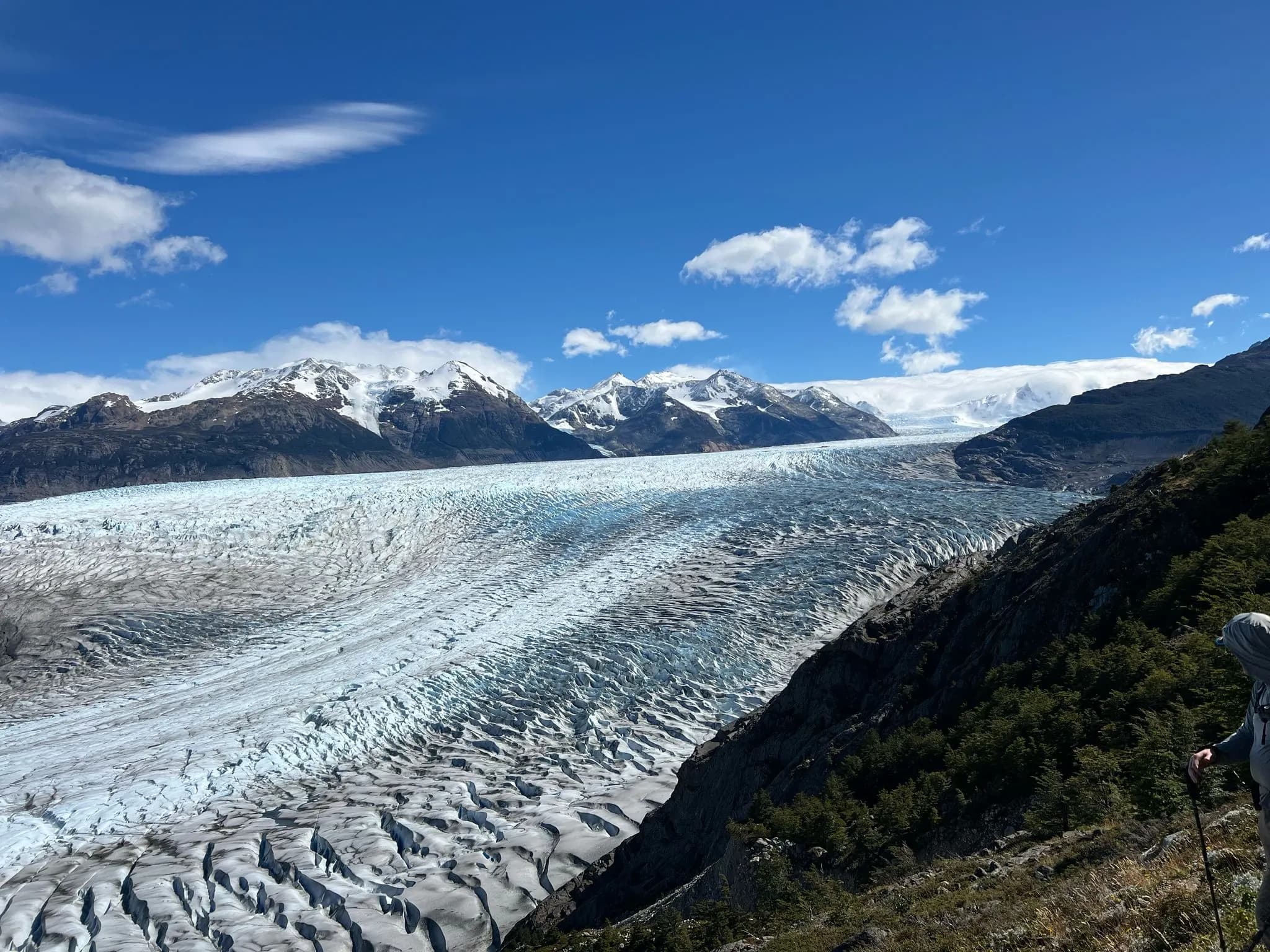
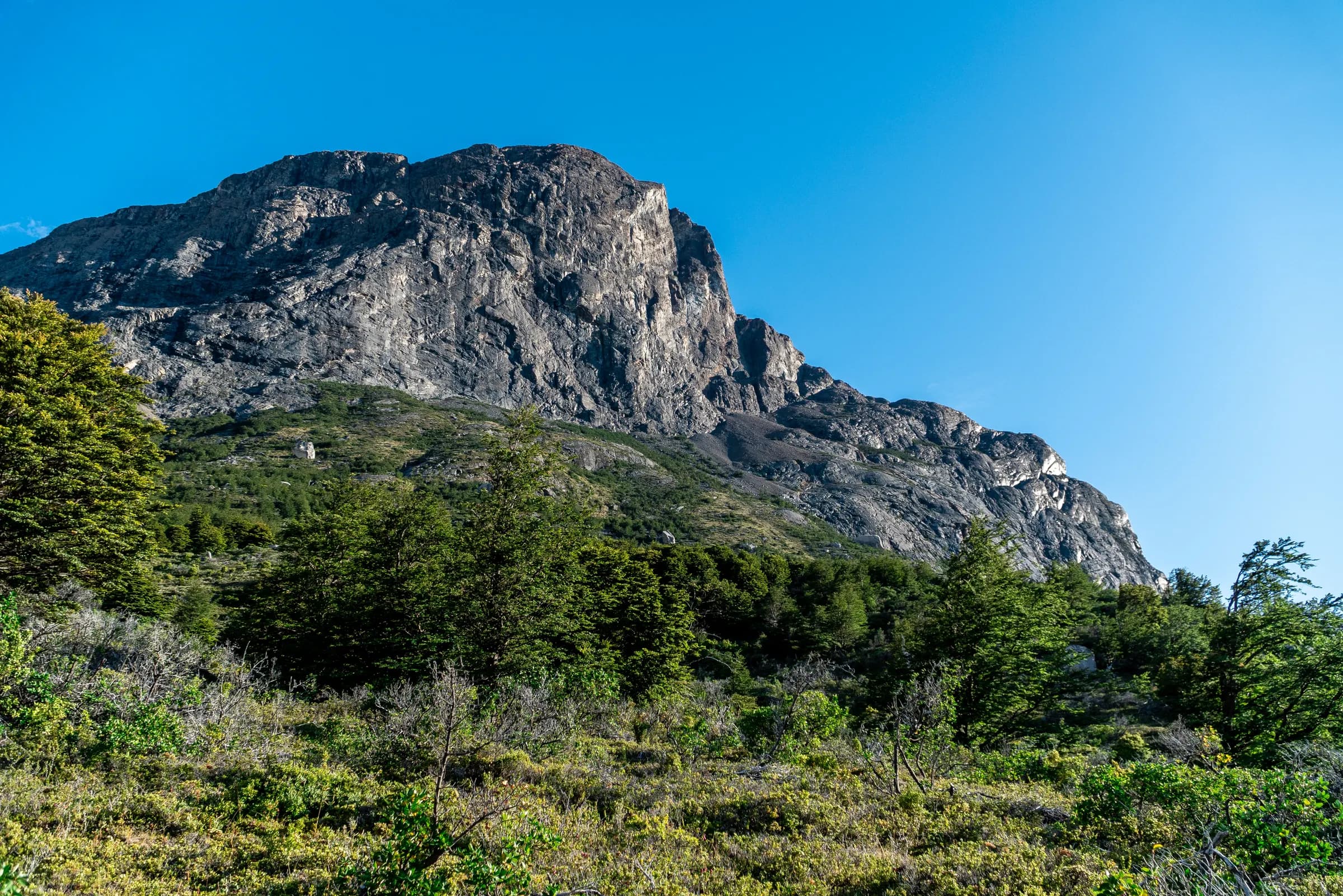
The Paine massif is a granite intrusion about 12 million years old, shaped by glaciers flowing from the Southern Patagonian Ice Field. What that means on the trail: loose rock, glacial boulders and stony moraines, with very few stretches of soft, even dirt.
A few sections show it clearly:
- The Base Torres moraine. The last part of the Base Torres hike is about 45 minutes of steep climbing over large, loose glacial boulders, exposed to the wind. You come down the same way, on tired legs, at the end of a day of about 22 km and roughly 1,400 m of gain.
- Lago Nordenskjöld. The trail between Central and Cuernos has no big climbs, but long sections are uneven and rocky, and the lake side is often windy.
- The north side of the O. From Dickson to Los Perros the trail climbs steadily on uneven ground with mud and roots. The next day, the climb to John Gardner Pass (1,200 m) crosses rocky, often muddy ground, and the descent to Lago Grey is steep, through forest and over three hanging bridges.
Then there is the vegetation. Calafate, the shrub that has become a symbol of Patagonia, is covered in three-pointed spines. Chaura, also called prickly heath, gets its scientific name mucronata from its sharp-tipped leaves. Both grow along the trails, and both scrape against thin mesh uppers all day.
This is where durability stops being a small detail. A trail runner's outsole may grip well on rock, but the upper is usually light mesh with a modest toe cap. A boot with a leather or heavy synthetic upper and a rubber rand around the toe takes kicks against rock and scrapes from spiny shrubs much better. Tired hikers stop lifting their feet as high, and that is when toes start hitting rocks.
That pair of light shoes torn apart between Dickson and Los Perros was mine. Since then I always hike in boots with ankle support. The terrain is so uneven that the higher cut saves your ankles again and again, and it costs nothing to switch to sandals at camp. I recommend brands like La Sportiva, Scarpa and Hanwag; La Sportiva's Boulder line in its Gore-Tex version is affordable and tough.
Ankle support: what the research says
The usual argument for boots is ankle support, and here it helps to be precise.
A 2025 laboratory study in the Annals of Biomedical Engineering simulated sudden ankle rolls in 20 athletes. Shoes with a collar just 3 cm higher reduced the peak inversion angle by between 7.6% and 19.6%, depending on the brand, and slowed the roll. That supports what guides see on the trail: a higher, firmer collar limits how far and how fast an ankle turns on a loose stone.
It is not a free pass, though. A 2024 study in Scientific Reports found that boots restrict ankle motion while walking, and that the hip and knee compensate for it. And the high-top study used basketball shoes in a lab, not hiking boots on a moraine. No boot replaces strong ankles, careful foot placement and trekking poles.
Our view after years on these trails: the risk comes from fatigue. On a multi-day trek, the rolled ankle usually happens late in the day, on a descent, when you are tired and stop watching every step. That is exactly when a supportive boot does its most useful work. Far from help, a sprain can mean the end of the trek for you, and a long, slow walk out.
I sprained my ankle guiding a W Trek, on the first of five days. I was wearing low-cut shoes and turned to look at a bird on a branch on the Valle Francés trail, near Mirador Skottsberg. I strapped the foot quickly and kept guiding, because I wasn't going to leave my group. It turned out to be a grade 2 sprain and it hurt a lot. I have never guided in low-cut shoes again.
Wet, cold and windy: why waterproof matters here
The park's climate is cold, wet and highly variable, with no dry season. A 2013 profile of the park published by the Spanish environment ministry records winds of up to 150 km/h and temperatures from 23 °C in summer down to −2.5 °C in winter. The local municipality notes that wind can make it feel 6–7 °C colder, and that the park's water is usually around 4–5 °C.
In that setting, a wet foot is a cold foot, and it also blisters more easily. Joseph Knapik's review of blister prevention for military medicine explains why: as feet get moist, skin cells stick together and friction rises. That is why a waterproof membrane (Gore-Tex or a similar brand) earns its place in Patagonia, even though it makes boots warmer and slower to dry. On a windy, overcast day at 5 °C, the advice that trail runners dry quickly is less useful than it sounds.
Snow is the other factor, especially on the O. The park can close the circuit when conditions turn: in September 2023, more than a meter of snow kept the O closed through October, and on March 26, 2026 CONAF closed it early because of compacted snow, continuous ice and loss of the trail in exposed sections. Even in season, you may cross snow or slush near John Gardner Pass, and a boot keeps your feet warmer and drier there than mesh.
In winter, the rules become explicit. From April 27 to August 30, CONAF requires a guide on the W and the Base Torres trail and lists the equipment it expects: poles, microspikes or crampons, a headlamp, sunglasses, gloves, warm and waterproof clothing and gaiters. Microspikes fit a stiffer boot far better than a soft running shoe.
How to choose your boots for Patagonia
You don't need heavy mountaineering boots for the W, the O or Base Torres. What you need:
- Mid or high cut. It wraps the ankle and raises the "flood line" for puddles and stream crossings.
- A waterproof, breathable membrane. Gore-Tex or an equivalent.
- A lugged rubber outsole. Deeper lugs grip better on loose rock; check the sole isn't worn down if the boots aren't new.
- A protective toe and rand. For kicks against rock on long descents.
- Room for your toes going downhill. Try boots on at the end of the day, when your feet are at their largest, with the socks you will hike in, and check that your toes don't hit the front on a slope.
- Broken in. We ask for boots worn for at least a month before the trip, not new. Walk in them on hills, with the pack you will carry.
Socks and blisters
Pack wool hiking socks, a pair for each two or three days plus one pair kept dry for camp. A thin liner sock under the wool sock helps some hikers: in a Marine Corps study cited by Knapik, a wool-polypropylene sock with a polyester liner cut serious blisters compared with standard socks alone. A 2017 systematic review in Wilderness & Environmental Medicine found that paper tape on known hot spots had the best evidence among the prevention methods studied.
Camp shoes, gaiters and poles
On the W and the O, the trip lists include camp shoes: something light to wear around the refugio or campsite so your boots can air out and your feet can rest. Low gaiters stop mud, stones and rain running into the boot, and they are on CONAF's winter list. Trekking poles take load off your knees on the descents and help with balance in wind.
Footwear by trip and season
| Trip | What you walk on | Our recommendation |
|---|---|---|
| Base Torres day hike | About 22 km, +1,400 m, loose moraine at the top | Broken-in waterproof boots with ankle support; poles recommended |
| Torres del Paine Classic | Viewpoints, Playa Grey walk; Base Torres if you choose it | Broken-in hiking boots; on Base Torres, as above |
| Torres del Paine Active | Base Torres, the Cuernos sector, puma tracking over uneven ground | Broken-in hiking boots; poles and crampons are provided |
| W Trek (5 days, about 68 km) | Rocky lakeside trail, Valle Francés, windy stretches to Grey | Broken-in waterproof boots, wool socks, camp shoes |
| O Circuit (8 days, about 138 km) | Mud and roots on the north side, John Gardner Pass at 1,200 m, steep descent | Waterproof mid or high boots, gaiters, camp shoes, spare dry socks |
| Winter (April 27 to August 30) | Possible snow and ice; guide required on the W and Base Torres | Waterproof boots that take microspikes or crampons, gaiters, poles |
What you carry also matters. On our W and O treks, porters are available as an add-on. Without them, you carry your own pack between refugios, and on our self-guided trips we suggest 50–65 L. The heavier the pack, the stronger the case for a supportive boot.
If you still want trail runners
Some experienced hikers do the W in trail runners and are happy with it. If that is you, reduce the risk:
- Only choose them if you already hike long, rocky days in trail runners at home, carrying a loaded pack.
- Pick a model with a firm heel counter, a rock plate and a reinforced toe, not a road-running shoe.
- Wear low gaiters and wool socks, and carry two spare dry pairs.
- Use trekking poles, especially on the Base Torres moraine and the descents.
- Avoid them for the O, for any trip in shoulder season, and for winter.
- Tell us before the trip. On a guided trek, your guide needs to know what is on your feet when deciding on timing and turnaround points.
Bottom line
Trail runners win on weight and comfort straight out of the box. In Torres del Paine, rocky ground, spiny shrubs, cold water, wind and long descents on tired legs make boots the safer choice for most hikers, which is why we ask for them on every trip.
If you are deciding which trek suits you, our Torres del Paine travel guide covers the routes, seasons and logistics. On the W Trek Guided, your pre-trek video call with the guide covers the route, the daily plan and your gear, so it is a good moment to ask about your boots, and the guide checks them again at pickup. For the full loop and John Gardner Pass, see the O Circuit Guided. And if you would rather test your boots on one long day first, the Base Torres day hike or the hotel-based Torres del Paine Classic are good places to start. For anything else, we can build a tailor-made trip around your dates.