Torres del Paine National Park sits at about 51° south in Chilean Patagonia, and most trips into it start in the small town of Puerto Natales. You can visit all year. The questions that shape your trip are always the same: how to get there, which season to choose, refugio or hotel, and guided or on your own. We guide in this park every season, so this guide answers those questions with the distances, hours and rules we work with on the trail.
Torres del Paine at a glance
- Where: Torres del Paine commune, Última Esperanza province, Magallanes region, Chile
- Size: 227,298 hectares
- Created: May 13, 1959; UNESCO Biosphere Reserve since 1978
- Gateway town: Puerto Natales
- Airports: Punta Arenas (PUQ), flights all year; Puerto Natales (PNT), seasonal flights
- Time you need: 5–8 days for a trek or a hotel-based program; one full day is enough for Base Torres or Grey Glacier on their own
- Main treks: the W (about 68 km in 5 days) and the O (about 138 km in 8 days)
- Park pass: sold online only, not at the gate
- Weather: sun, rain and strong wind on the same day, in any month
Where the park is and how to get there
Torres del Paine is in the far south of Chile, in the Magallanes region. There is no airport inside the park. You fly to Punta Arenas or Puerto Natales, then travel by road.
Flying in: Punta Arenas or Puerto Natales
- Punta Arenas (PUQ) has flights all year. From Punta Arenas it is about 250 km, roughly 3 hours by road, to Puerto Natales.
- Puerto Natales (PNT) has seasonal flights from Santiago and Puerto Montt. It saves you the drive from Punta Arenas, but it does not operate all year.
One note for the 2026–27 season: Chile's Ministry of Public Works has scheduled runway works at the Puerto Natales airport between January and March 2027. It has said the airport will not close completely and that commercial flights will keep operating on weekends, but with fewer flights than usual on other days. If you plan to fly into Natales in those months, check your flight carefully and keep Punta Arenas as your backup.
From Puerto Natales into the park
The park has several entrances, and the drive depends on where you are going:
- Laguna Amarga, the entrance for the Las Torres sector and the Base Torres trail, is about 129 km from Puerto Natales.
- Río Serrano, on the southern side, is about 80 km away.
- Lago Sarmiento is about 112 km away.
- Pudeto is where the catamaran crosses Lago Pehoé to Paine Grande, a 30–40 minute crossing.
Plan on 2–4 hours from Puerto Natales to the park depending on the entrance. On our Base Torres days we leave Natales around 06:00 and start walking around 07:45. If you book any Vertic trek or hotel-based trip, the transfers between the airport, Puerto Natales and the park are arranged for you.
When to go: Torres del Paine season by season
The short answer: October to April is the main season, with the longest days and every route open. December to February is the busiest stretch, so book early. Winter, from May to September, is quiet, cold and the season we like for pumas, but it comes with extra park rules.
The light changes a lot at this latitude. These are daylight hours we computed for 51° S:
| Date | Daylight |
|---|---|
| June 21 | about 8 hours |
| October 15 | about 14 hours |
| November 15 | about 15.5 hours |
| December 21 | about 16.5 hours |
| February 15 | about 14.5 hours |
| March 21 | about 12 hours |
| April 15 | about 10.5 hours |
The municipality of Torres del Paine puts summer highs at around 20°C and winter temperatures down to around 0°C, and notes that the wind can make it feel 6–7°C colder. The lakes stay at 4–5°C all year. In practice that means you pack for cold and wind in every month.
Spring (October–November)
The park wakes up: wildflowers on the steppe, newborn guanacos (chulengos) and days already longer than 14 hours. Our fixed group departures for the W (October) and the O (November) run in this window. Wind can be strong in spring, as in every season.
Summer (December–February)
The longest days of the year and every trail open. It is also the busiest time, when refugio and campsite nights sell out first. If you want these dates, book months ahead.
Autumn (March–April)
Crowds thin out, the light turns golden and the lenga forests turn red. Days get shorter fast: by mid-April you have about 10.5 hours of light, which matters on long trekking days.
Winter (May–September)
Snow on the peaks, trails almost to yourself and, in our guides' experience, the best chances to watch pumas on the eastern steppe. Winter also brings the park's winter rules (see below), shorter days and fewer boat departures on Lago Grey.
Every month here has something, but if I had to choose I'd take autumn and spring. In autumn the park turns red, and those reds against the pampa, the lakes and the rivers look like another planet. In spring the trees bud and the whole landscape goes from gray to a bright green. Winter snow gives the park a contrast of its own, and summer brings powerful wind together with long sunny days.
Winter rules: when you need a guide
CONAF, the agency that manages Chile's national parks, applies a winter regulation for Torres del Paine. In 2026 the winter period ran from April 27 to August 30, and during that time:
- A CONAF-authorized guide is required on the Base Torres trail and on the W.
- Winter equipment is required: microspikes, trekking poles and a headlamp, among other items for snow, ice and low visibility.
- Hiking at night is not allowed.
CONAF can extend these dates when snow and ice stay on the trails. In 2026 it extended the guide requirement for Base Torres and the W to September 15. In June and July 2026 the W was also closed, while the Base Torres trail stayed open with a guide.
The O has its own calendar. The back section of the circuit (the north and west side, over John Gardner Pass) closes in winter, and CONAF has announced it stays closed until October 31, 2026. That is why our O departures start in November.
Park passes: the 2026 fee system
Since May 1, 2026, CONAF uses a new fee system for Torres del Paine. The old structure, one price for up to three days and another for longer visits, was replaced by two kinds of entry:
- Single-day entry: valid for one day.
- Multi-day entry: valid for 2 or more consecutive days, up to a maximum of 10 days.
Prices vary by category (Chilean residents, foreign visitors, children, seniors, people with disabilities and companions). We have not found the current amounts published on an official CONAF page we can cite, so check the official sales site, pasesparques.cl, for this season's prices before you travel.
Three practical points:
- Passes are sold online only, not at the gate. Buy yours before you travel to the park.
- Carry it with your passport, on your phone or printed.
- On a Vertic trip, the park entrance is included. We buy it and send it to you.
Refugios and campsites: book before you arrive
You can only sleep in the park at authorized refugios and campsites, and every night has to be booked before you arrive. There are no walk-up nights. Here are the sites on the W and the O, in the order you meet them on the O:
| Site | Type | What it's like |
|---|---|---|
| Camping Serón | Camping only | A grassy campsite in open country on the first stretch of the O, where guanacos and other wildlife are often around. Hot showers, a restaurant and a small shop. |
| Refugio & Camping Dickson | Refugio and camping | An isolated spot in the northwest of the park, on open grassland by Lago Dickson. Dorm refugio, campsite, hot showers, a restaurant and a cooking area. |
| Camping Los Perros | Camping only | A basic campsite in the forest, sheltered from the wind, the last stop before John Gardner Pass. Cold showers only. |
| Refugio & Camping Grey | Refugio and camping | Between Lago Grey and the mountains, a short walk from the Grey Glacier viewpoints. Dorm refugio, campsite, hot showers, a restaurant and a cooking area. |
| Refugio & Camping Paine Grande | Refugio and camping | On open ground by Lago Pehoé, facing the Cuernos del Paine, where the catamaran docks. Dorm refugio, campsite, hot showers and a restaurant and café. |
| Camping Francés | Camping and cabins | Tent platforms on wooden decks set into a wooded slope above Lago Nordenskjöld. Hot showers and a restaurant. |
| Refugio & Camping Cuernos | Refugio, camping and cabins | Below the Cuernos del Paine on the shore of Lago Nordenskjöld. Tent platforms in the forest, cabins, a refugio, hot showers and a restaurant. |
| Refugio & Camping Central | Refugio and camping | In the Las Torres sector, a short drive from the Laguna Amarga entrance, at the foot of the valley that leads to Base Torres. Grassy campsite, a refugio with dorms, hot showers, a restaurant and a small shop. |
The sites are run by different concessionaires with separate booking systems, and your nights have to line up with the direction you walk. That is the part of a trek that is hardest to arrange from abroad. On our W and O trips we book every night in advance; depending on availability you sleep in a shared dorm at the refugio or in a tent at the campsite, with tent, sleeping bag and mat included on camping nights.
The W, the O, day hikes or a hotel base: how to decide
Most people choose between four ways of seeing the park. Start with your days and your fitness, then decide if you want to carry a pack between refugios.
The W Trek
The W follows the south face of the Paine massif and links the park's three main valleys: Base Torres, Valle Francés and Grey Glacier. We walk it east to west in 5 days, about 68 km (42 mi), plus 4 km if you add Mirador Británico. The hardest day is the first, the Base Torres hike: about 22 km with roughly 1,400 m of elevation gain, usually 8–10 hours. After that the days run 11–20 km on rocky, windy trail, and the trek ends with a boat to the face of Grey Glacier. We rate it intermediate to advanced.
- W Trek Guided: 5 days with a Vertic guide, October to April.
- W Trek Self-Guided: the same route without a guide; we book your nights, park pass, boat and transfers.
- W Express Guided: the W in 4 days, with two days of 22–24 km.
The O Circuit
The O is the full loop around the massif: about 138 km (86 mi) in 8 days, counterclockwise, the only direction the park allows. The first half crosses the quiet north side of the park, along Río Paine to Lago Dickson and up the Los Perros valley. Day 4 crosses John Gardner Pass at 1,200 m, with Grey Glacier and the Southern Patagonian Ice Field below you. That day is about 17 km and 10–12 hours is normal, and the circuit's longest stage, through Valle Francés, is 26.7 km. The second half joins the W. We rate it advanced.
- O Circuit Guided: 8 days with a Vertic guide, November to March.
- O Circuit Self-Guided: the same loop with independent navigation; we book all seven nights, park pass and transfers.
For this season's status and rules, see our O Circuit 2026-27 guide.
Day hikes and hotel-based trips
You do not need to carry a pack to see the park. From a hotel in Puerto Natales you can go out for single days and sleep in a bed every night:
- Day Hike to Base of the Towers: about 22 km round trip and around 1,400 m of gain, about 12 hours door to door, offered all year.
- Navigation to Grey Glacier: about 2 hours 45 minutes on Lago Grey after a 30–45 minute walk across Grey Beach. Easy, and good for families.
- Torres del Paine Classic: 5 days, low difficulty, with a flexible full day in the park, a 3-hour horseback ride and the Grey Glacier boat.
- Torres del Paine Active: 7 days, adding Base Torres, an active day in the Cuernos sector, horseback riding and puma tracking.
Which one fits you
| Your situation | Our suggestion |
|---|---|
| 5 days, good fitness, you want the classic multi-day trek | W Trek Guided or Self-Guided |
| 4 days, strong legs, short on time | W Express Guided |
| 8 days, experienced trekker, you want the whole park | O Circuit Guided or Self-Guided |
| You want a bed every night, or mixed fitness in the group | Torres del Paine Classic |
| You want variety: trail, horses, wildlife, glacier | Torres del Paine Active |
| One or two days in the area | Base Torres day hike, Grey Glacier navigation, puma tracking |
| Traveling between late April and mid-September | A hotel-based program or a guided day hike (guide required on Base Torres and the W) |
If you want to join a small group on set dates, our fixed departures for 2027 cover the Active (September), the W (October) and the O (November).
The highlights, place by place
Base Torres
The glacial lagoon at the foot of the three granite towers is the reason most people come. The trail climbs the Ascencio valley, crosses Paso de los Vientos, drops to Refugio Chileno and continues through lenga and coigüe forest. The last stretch is a steep moraine of large boulders, about 45 minutes of effort, open to the wind. Our guided days reach the lagoon around midday, which leaves time to eat and still come down with margin. For 2026, CONAF confirmed that no new access restrictions would apply to the Base Torres trail, apart from the winter guide rule.
Valle Francés and the Cuernos
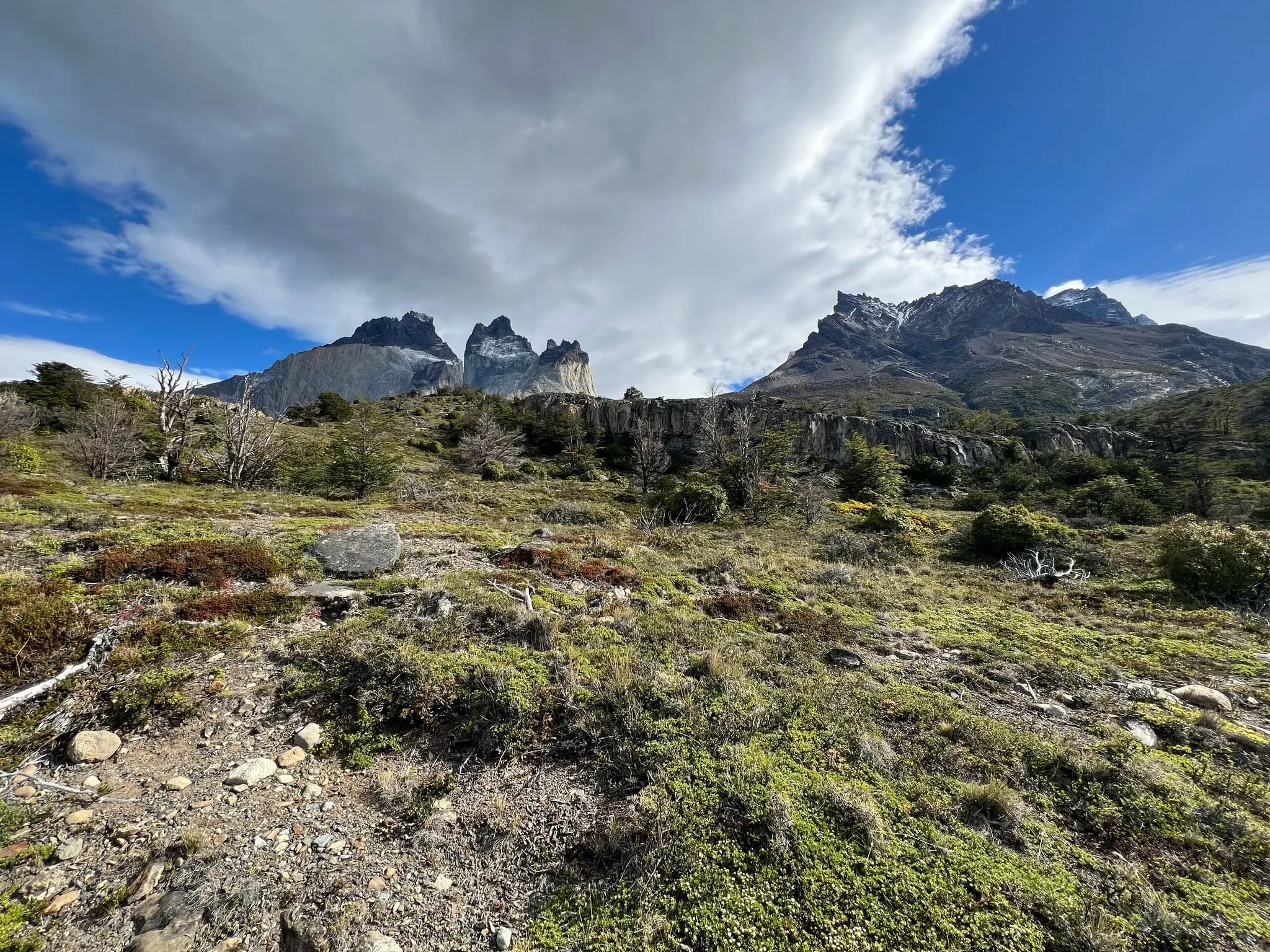
From the Italiano sector, the trail climbs into Valle Francés to Mirador Francés and, further up, Mirador Británico, a ring of peaks at the top of the valley. Before and after, the trail along Lago Nordenskjöld runs directly below the Cuernos del Paine. The park sets afternoon cutoff times on the valley trail, so the start time from Cuernos or Paine Grande matters.
Grey Glacier
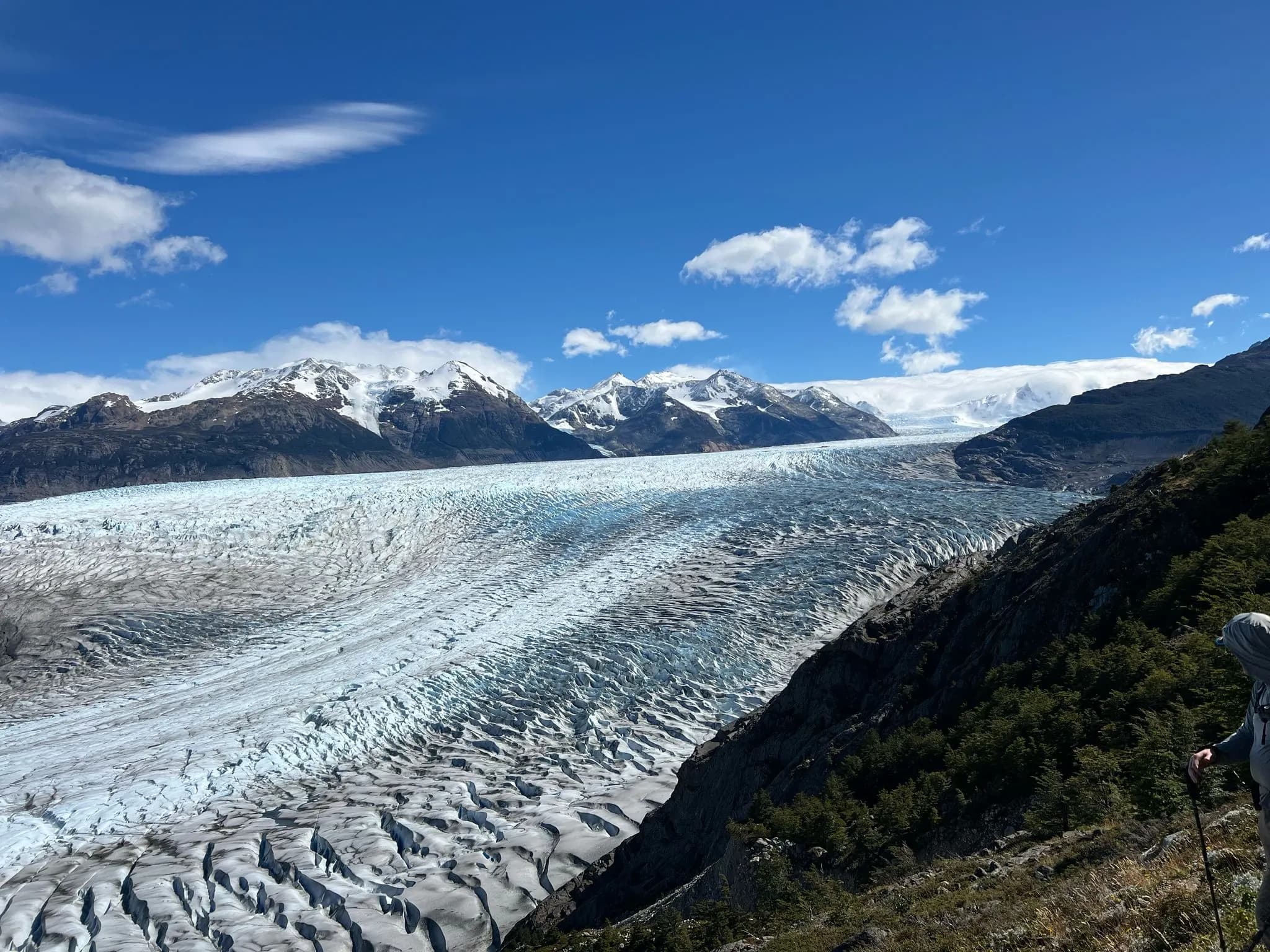
There are two ways to see it. On foot, from Mirador Grey and the suspension bridges on the trail past Refugio Grey, with views over the ice. On the water, a catamaran sails among icebergs to the glacier face, about 2 hours 45 minutes on Lago Grey. Departures depend on wind, and from May to August the boat runs on fewer days. On our Classic program, if the boat stays in port, the guide swaps it for a walk across Grey Beach to the iceberg viewpoint, plus the short trail to Salto Grande and Mirador Cuernos.
Laguna Amarga and the eastern steppe
The eastern sector of the park, around Laguna Amarga, is open steppe and lagoons with the massif on the horizon. It is also puma country, with one of the highest puma densities in the world. Pumas are most active at dawn and dusk, so tracking days start before sunrise. Read our guide to puma tracking in Torres del Paine, or book a day on the Puma Tracking in Patagonia experience. Sightings are never guaranteed, which is why some travelers book two or more days.
Wildlife and horses
Guanacos are everywhere on the steppe. Andean condors, foxes and ñandús are likely sightings, and CONAF counts 125 bird species in the park. Outside the park, near Puerto Natales, you can ride with local baqueanos on a working estancia; our Patagonia Horseback Riding runs from October to April, from a 1-hour ride for first-timers to a 6-hour ride for confident riders.
Park rules you need to know
These are the rules we follow on every trip, from CONAF's regulations for the park:
- No fires, anywhere. Lighting any heat source (fires, grills, cigarettes) is prohibited under Chilean law (Law 20,653). Gas stoves are allowed only in the designated cooking areas of campsites.
- Sleep only at authorized sites. Camping outside refugios and campsites is not allowed.
- Stay on marked trails. Walking off authorized trails is not allowed.
- Pack out everything. All waste you generate has to leave the park with you.
- Walk the O counterclockwise. Some northern sections are one-way.
- Respect checkpoint cutoffs. On some trails, including Base Torres, Valle Francés and the start of John Gardner Pass, the park closes the trail to late starters.
- Follow the winter rules from late April to the end of August (and any extension).
Safety and weather
Patagonian weather is the main safety factor in Torres del Paine. Expect sun, rain and strong gusts on the same day, in any month. Wind is constant on exposed sections: the Base Torres moraine, the shore of Lago Grey and John Gardner Pass.
What keeps a day safe here:
- Start early. Long days, cutoff times and afternoon wind all favor an early start.
- Dress in layers, not one warm jacket. You will add and remove layers all day.
- Know your turnaround time, and use it. On our trips the guide has the authority to change the route or stop the ascent if conditions become unsafe.
- Carry travel insurance that covers trekking in remote terrain. It is required on every Vertic trip and is not included.
On every guided trip, someone is watching the weather, the group's pace and the clock for you. I wrote this guide as a certified Torres del Paine guide, and those three things decide most days on the trail.
You only learn what wind really is when you come here. I haven't felt gusts like these anywhere else in the world: constant, and strong enough to tip over a car. It is part of the Patagonian experience, and after all these years I've come to like it.
What to pack
The list is the same for the W, the O and hotel-based days, with a bigger backpack if you carry your own gear:
- Layers: waterproof jacket and waterproof pants, a warm mid layer (fleece or down), quick-dry base layers, warm hat and gloves
- Feet: broken-in hiking boots, wool socks, camp shoes for treks
- On the trail: daypack with rain cover (a 50–65 L backpack for self-guided treks without porters), trekking poles, headlamp, reusable water bottle
- Sun: sunglasses, sunscreen, sun hat
- Documents: passport, park pass, travel insurance details
- Winter: microspikes or crampons, gaiters and warm, waterproof clothing, as the winter rules require
The question we hear most is about footwear. The Base Torres moraine and the pass on the O are hard on new shoes and city sneakers. We cover this in detail in hiking boots or trail shoes for Patagonia.
Guided or self-guided?
Both work on the W and the O. The difference is who makes the decisions on the trail.
Self-guided suits independent hikers who are comfortable navigating alone. On our self-guided trips we arrange every night, the park pass, meals during activities and the transfers in and out. You handle route-finding, daily timing, check-ins and decisions on weather. There is no guide and no briefing, so you need to study the route and the cutoff times before you arrive.
Guided suits travelers who want someone else managing pace, timing and conditions, or who are traveling in winter, when a guide is required on Base Torres and the W. Our guided treks add a Vertic guide on every stage and a pre-trek video call with your guide, and the W includes the Grey Glacier boat. Porters can be added on either version.
A simple test: if a cutoff time, a closed trail or a change in the forecast would stress you, choose guided. If you enjoy planning your own day and have hiked multi-day routes before, self-guided gives you more freedom.
Plan your trip with us
Torres del Paine rewards early planning: book refugio nights months ahead for December to February, buy your pass online, and check the season's rules before you fly. If you want us to put it together, start with the trips above or our Patagonia travel guide, or tell us your dates and we will suggest the route that fits.